





Alternatives to jail are legally sanctioned sentences and programs that replace incarceration with rehabilitation, supervision, or community accountability. Courts across the United States now recognize that locking someone up is not always the most effective response to a criminal charge. Diversion programs, specialty courts, electronic monitoring, and restorative justice each offer a path that keeps defendants out of a cell while addressing the root causes of their behavior. If you are facing charges right now, understanding these options could change the outcome of your case.
1. What are the most effective alternatives to jail?
Diversion programs are the most powerful non-custodial option available to defendants today. They redirect eligible individuals away from traditional prosecution and into supervised treatment or education tracks. Complete the program successfully, and the charges are typically dismissed or reduced.
The results are measurable. Forensic Diversion participants spend an average of 24 days in jail compared to 61 days under traditional sentencing. That is a 55% reduction in incarceration time. The same programs cut felony rearrests by 37% for standard diversion participants and by 44% for Day Reporting Drug Court participants.

California offers several statutory diversion tracks, including PC 1000 for drug offenses, Judicial Diversion under PC 1001.95, and Mental Health Diversion under PC 1001.36. Each has specific eligibility criteria, but all share the same goal: treatment over punishment.
Pro Tip: Ask your attorney about informal diversion before your arraignment. Getting into a program early signals accountability to the court and strengthens your position before a judge ever rules on your case.
2. How do specialty courts work as sentencing alternatives?
Specialty courts, including drug courts, mental health courts, and veterans courts, operate on a fundamentally different model than standard criminal courts. Treatment courts shift from an adversarial process to a collaborative one. Judges, prosecutors, defense attorneys, and clinical specialists work as a team focused on your recovery rather than your conviction.
Judge Wayne S. Trockman, who oversees a treatment court program, states directly that investing in evidence-based treatment produces safer communities and a stronger return for taxpayers than cycling defendants through traditional incarceration. That is not an opinion. The Forensic Diversion program he references saved $1.15 million for study participants alone and is projected to save $16 million over 10 years.
Specialty courts use graduated responses to noncompliance. A missed check-in might result in a brief jail stay or courtroom observation rather than full revocation. This keeps participants in the program and maintains rehabilitation momentum without derailing their progress.
- Drug courts: Target substance use disorders with mandatory treatment, regular drug testing, and court check-ins
- Mental health courts: Connect defendants with psychiatric care, medication management, and community support
- Veterans courts: Combine VA services with peer mentorship from fellow veterans
- DUI courts: Require alcohol monitoring, treatment, and driving restrictions for repeat offenders
3. How do electronic monitoring and house arrest function?
Electronic monitoring is a court-ordered supervision tool that tracks your location using GPS or radio frequency technology. It is one of the most common alternatives to jail time for DUI offenses and nonviolent crimes. The court sets the terms, and a monitoring agency enforces them.
Daily fees for electronic monitoring range from a few dollars up to $40, plus installation fees at program start. That cost falls on the defendant in most jurisdictions. Over a 90-day monitoring period, total costs can reach several hundred dollars even at the low end.
Three main formats exist:
- Curfew monitoring: You must be home during specified hours, typically overnight
- Full house arrest: You leave only for approved activities like work, medical appointments, or court dates
- Alcohol monitoring devices: SCRAM bracelets detect alcohol through perspiration and report violations in real time
Violations carry serious consequences. A single confirmed breach can result in immediate arrest and revocation of your monitoring status. The advantage is that you keep your job, stay with your family, and avoid the collateral damage that comes with a jail record.
4. What community-based sentences serve as alternatives?
Community service and probation are the most widely used community-based sentencing alternatives. They require real accountability but allow defendants to remain in their homes and maintain employment.
Probation places you under court supervision for a defined period, typically one to three years for misdemeanors and longer for felonies. Conditions usually include regular check-ins with a probation officer, drug testing, no new arrests, and sometimes mandatory treatment. Violating any condition can send you to jail immediately.
Restorative justice programs take a different approach. Rather than focusing on punishment, they bring together the defendant, the victim, and community members to address the harm caused. Restorative justice programs show lower reoffending rates and greater victim satisfaction compared to custodial sentences. Formats include:
- Victim-offender mediation: A structured dialogue between the defendant and the person harmed
- Community conferencing: A broader group process involving family and community members
- Sentencing circles: Indigenous-rooted practices that involve the wider community in determining accountability
Restorative justice works best for property crimes, low-level assaults, and first-time offenses. It remains debated for serious violent crimes, where victim safety and trauma must be weighed carefully.
5. What are the real financial and lifestyle costs?
Avoiding jail does not mean avoiding costs. Defendants in alternative programs face ongoing expenses including monthly supervision fees, drug testing, treatment session copays, and administrative program fees. These costs accumulate over months or years and can total thousands of dollars.
Time is the other hidden cost. Multi-year probation can be more demanding and restrictive than a short jail sentence. Weekly check-ins, mandatory treatment sessions, random testing, and travel restrictions consume significant time. Defendants who underestimate this burden often struggle to comply, which puts them at risk of revocation.
Pro Tip: Before accepting any alternative sentence, map out the full monthly cost including fees, testing, and treatment. Then compare that to the length of the program. Some defendants with limited resources find that a shorter jail term creates less long-term financial strain than a two-year supervised program.
Record impact is another factor most defendants overlook. Completing a diversion program typically results in dismissed charges and no conviction on your record. Probation, by contrast, usually follows a guilty plea, which means a conviction exists even if you complete the program without incident. The difference matters for employment, housing, and professional licensing.
6. What about alternatives to jail for mental health and DUI cases?
Mental health and DUI cases have dedicated alternative pathways that address the specific conditions driving the offense. For defendants with a diagnosed mental health condition, Mental Health Diversion under PC 1001.36 allows charges to be dismissed after successful treatment. Eligibility requires a qualifying diagnosis and a treatment plan approved by the court.
For DUI cases, alternatives to jail time include DUI courts, alcohol monitoring devices, mandatory treatment programs, and ignition interlock devices. These options are especially relevant for first-time offenders and defendants who can demonstrate a commitment to sobriety before sentencing. Courts respond positively to defendants who begin behavioral health treatment voluntarily before their hearing date.
Veterans facing criminal charges have access to veteran diversion programs that route them into VA-coordinated care rather than traditional prosecution. These programs recognize service-related trauma, PTSD, and substance use as contributing factors and treat them accordingly.
7. How does proactive mitigation improve your chances?
Proactive mitigation means taking concrete steps before your court date to demonstrate accountability and commitment to change. Courts weigh these actions heavily when deciding whether to approve an alternative sentence. Starting treatment, completing an assessment, and submitting documentation before sentencing gives the judge evidence to act on.
Exectreatmentsolutions builds pretrial mitigation plans that include substance abuse assessments, mental health evaluations, drug and alcohol testing, and detailed progress reports delivered directly to your attorney. These documents show the court that rehabilitation is already underway. Judges and prosecutors are far more likely to approve diversion when a structured plan is already in place.
The earlier you start, the stronger your case. Defendants who qualify for diversion with documented treatment progress have a measurably better outcome than those who wait until sentencing to act. Mitigation is not a last-minute strategy. It is a front-loaded investment in your case.
Key Takeaways
Diversion programs, specialty courts, and community-based sentences are the most effective alternatives to incarceration because they reduce both jail time and the likelihood of reoffending.
| Point | Details |
|---|---|
| Diversion cuts jail time by 55% | Participants average 24 days incarcerated versus 61 days under traditional sentencing. |
| Specialty courts reduce reoffending | Felony rearrests drop by 37–44% for treatment court participants compared to standard prosecution. |
| Electronic monitoring has real costs | Daily fees reach up to $40 plus installation, and violations result in immediate arrest. |
| Alternative sentences carry hidden burdens | Monthly fees, testing, and treatment sessions can total thousands of dollars over a multi-year program. |
| Early mitigation improves outcomes | Starting treatment before your court date gives judges documented evidence to approve diversion. |
What I’ve learned about choosing the right path
Most defendants I’ve seen come to this decision the wrong way. They hear “alternatives to jail” and assume it means an easy out. It is not. The programs that work best are the ones that demand the most from you, and that is exactly why they produce better outcomes.
The research on specialty courts is not subtle. A 44% drop in felony rearrests is not a marginal improvement. It is a structural shift in how people move through the legal system. The collaborative model, where judges, attorneys, and clinicians work together toward recovery rather than conviction, changes what the courtroom is actually trying to accomplish.
What I find most underappreciated is the front-loading principle. Defendants who walk into court with a treatment plan already running, test results already documented, and a clinical team already engaged are presenting a fundamentally different case than someone who promises to get help after sentencing. Courts are not naive. They respond to evidence, not intentions.
The financial reality also deserves more honesty than it usually gets. A two-year supervised probation with monthly fees, weekly testing, and mandatory sessions is a significant commitment. For some defendants, especially those with unstable income, a shorter custodial sentence followed by a clean record may actually be the more practical choice. That is a conversation worth having with your attorney before you accept any offer.
The bottom line is this: the best alternative sentence is the one you can actually complete. Choosing a program you cannot sustain is not avoiding jail. It is delaying it.
— Jake
How Exectreatmentsolutions supports your case
Facing criminal charges is not the moment to figure out the system on your own. Exectreatmentsolutions provides pretrial mitigation and court advocacy services built specifically for defendants who want to qualify for diversion or reduced charges. The team deploys treatment plans fast, coordinates directly with your attorney, and produces the court documentation that judges need to approve alternatives.
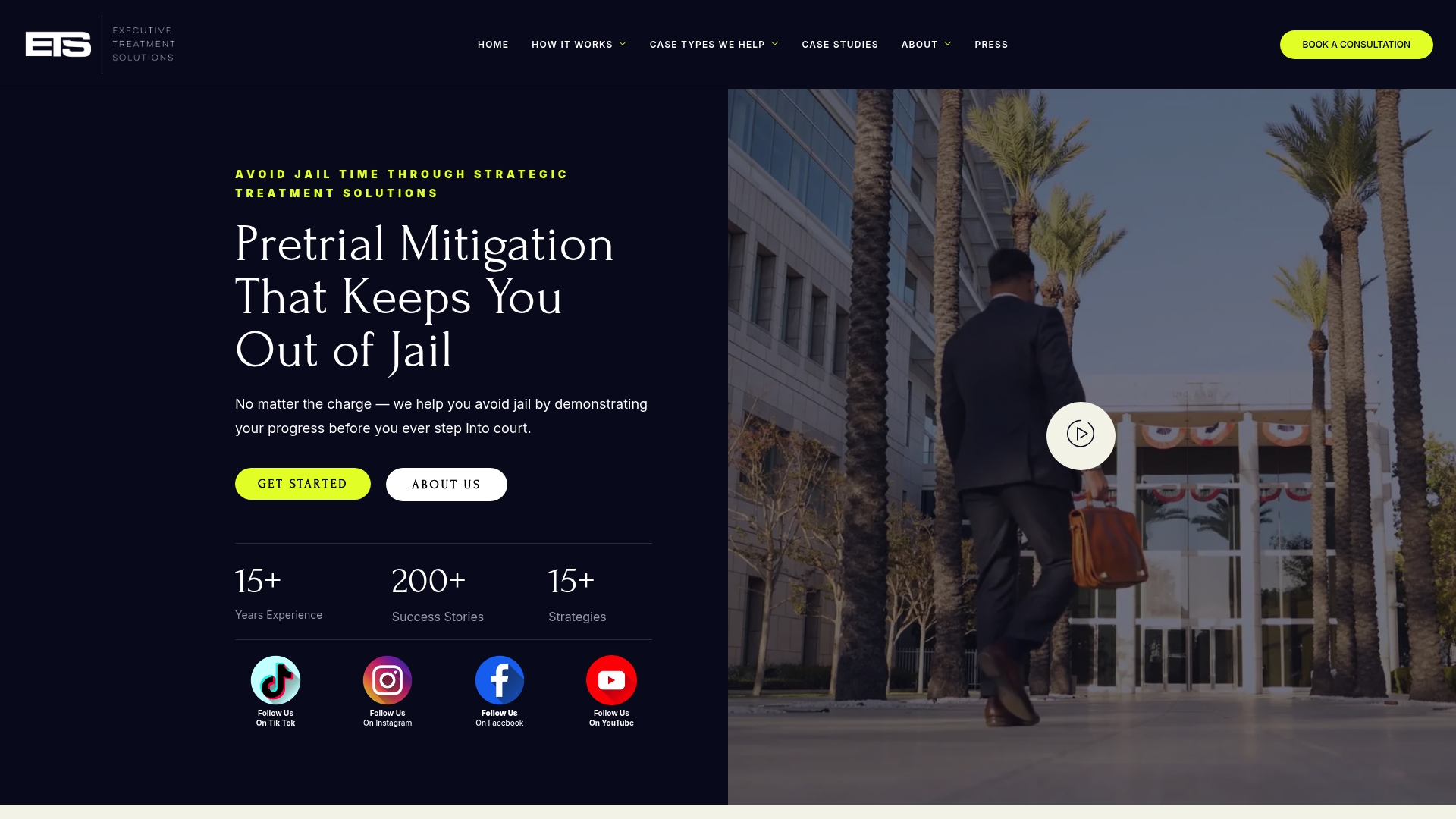
Services include substance abuse assessments, mental health therapy, drug and alcohol testing, and ongoing case management. Every element is designed to demonstrate accountability before your court date. If you are exploring how pretrial mitigation works and what it takes to qualify, Exectreatmentsolutions gives you a structured, evidence-based path forward.
FAQ
What qualifies someone for a diversion program?
Eligibility typically requires a nonviolent or low-level charge, no prior felony convictions, and a willingness to complete treatment or supervision conditions. Specific programs like PC 1000 or Mental Health Diversion have additional statutory requirements.
Are alternatives to jail available for DUI charges?
Yes. DUI courts, alcohol monitoring devices, ignition interlock requirements, and mandatory treatment programs are all recognized sentencing alternatives for DUI offenses, particularly for first-time defendants.
Does completing a diversion program clear your record?
Completing a diversion program typically results in dismissed charges, which means no conviction on your record. This differs from probation, which usually follows a guilty plea and leaves a conviction even after successful completion.
How much do alternative sentences cost?
Costs vary widely. Electronic monitoring fees reach up to $40 per day, and supervision programs add monthly fees, testing costs, and treatment copays that can total thousands of dollars over the program’s duration.
Can mental health conditions qualify someone for diversion?
Yes. California’s PC 1001.36 allows defendants with a qualifying mental health diagnosis to enter Mental Health Diversion, with charges dismissed upon successful completion of a court-approved treatment plan.


