





California DUI diversion is defined as a pretrial program that suspends criminal proceedings while a defendant completes treatment or education, with charges dismissed on completion. The problem is that California prohibits this for nearly every DUI defendant under Cal. Veh. Code § 23640. One exception exists: Military Diversion under Penal Code § 1001.80. If you are facing a DUI charge in California, understanding exactly what is off the table, what is available, and how to protect your license and record is the most important thing you can do right now.
What is California DUI diversion and why is it banned?
DUI diversion, in the general sense, is a program that lets a defendant avoid conviction by completing court-ordered requirements. Most states allow some form of it for first-time offenders. California does not. Cal. Veh. Code § 23640 explicitly forbids courts from suspending proceedings or granting diversion for any DUI defendant. That prohibition is not a gray area.
Two court decisions cemented this rule. Grassi v. Superior Court (2021) and Tan v. Superior Court (2022) both confirmed that judges cannot divert DUI cases, even when they believe it would serve justice. The legislature made a deliberate choice to keep DUI charges on a separate, stricter track.

A common misconception is that PC 1001.95, California’s general judicial diversion statute, opens a backdoor for DUI defendants. It does not. PC 1001.95 explicitly excludes DUI offenses under the same Vehicle Code prohibition. Courts cannot use that statute to work around the ban.
Here is what the statutory prohibition means in practice:
- No pretrial diversion for standard misdemeanor or felony DUI charges
- No judicial diversion under PC 1001.95 for DUI offenses
- No PC 1000 drug diversion when the charge is DUI rather than simple possession
- No suspension of proceedings while a defendant completes a treatment program
- One exception only: Military Diversion under Penal Code § 1001.80
What is Military Diversion and who qualifies?
Military Diversion is the sole DUI diversion option in California, authorized under Penal Code § 1001.80. It allows eligible military defendants to complete a treatment program instead of facing conviction. Successful completion results in dismissal of the charges.
Eligibility is specific. You must be an active-duty service member, a reservist, or a veteran. Beyond status, you must show that the DUI offense is connected to a service-related condition. Qualifying conditions include PTSD, traumatic brain injury (TBI), military sexual trauma (MST), and substance abuse disorders caused by military service.
The diversion period runs up to 24 months. During that time, the court monitors your progress through a treatment program tailored to your service-related condition. Completing the program leads to dismissal. Failing to comply returns the case to standard criminal proceedings.
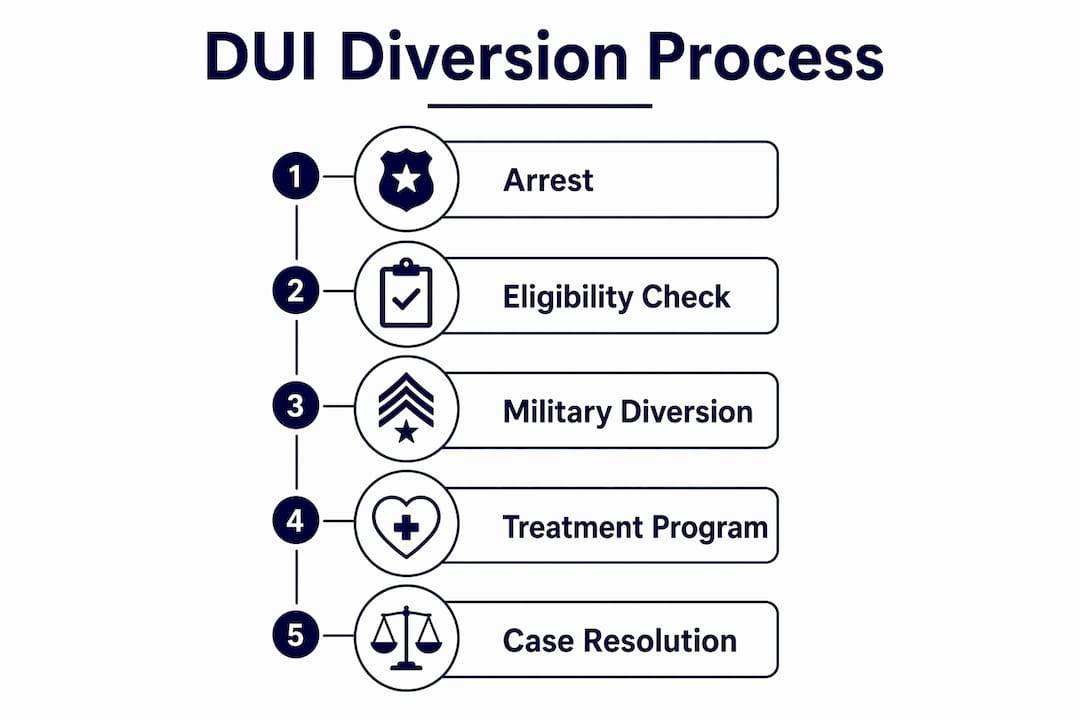
The documentation requirement is the hardest part for most applicants. Qualifying requires documented evidence linking the DUI offense directly to PTSD, TBI, MST, or service-related substance abuse. That means medical records, VA treatment records, and military service documentation. The nexus between the offense and the service-related condition must be clear and specific.
The process generally follows these steps:
- Retain a DUI attorney with experience in Military Diversion cases before your first court date.
- Gather military and medical records documenting your service-related diagnosis.
- File a motion requesting Military Diversion at or before the arraignment.
- Present evidence of nexus between your condition and the offense to the court.
- Enroll in an approved treatment program once the court grants diversion.
- Complete all program requirements within the diversion period to earn dismissal.
Pro Tip: Request your VA records and any private treatment records before your first court appearance. Courts grant Military Diversion motions faster when documentation is ready at the hearing.
What are the alternatives when DUI diversion is not available?
When diversion is off the table, the most effective legal strategy shifts to charge reduction and penalty mitigation. The most common target is a reduction to “wet reckless,” the informal name for a charge under VC § 23103.5. A wet reckless carries lower fines, no mandatory license suspension, and less stigma on your record than a DUI conviction.
Negotiating a wet reckless is not guaranteed. Prosecutors consider the blood alcohol level, driving behavior, prior record, and whether anyone was injured. A first-time offense with a BAC close to 0.08% gives your attorney the most leverage. Repeat offenses or elevated BAC readings make reduction harder to secure.
For defendants facing a second DUI offense, the penalties are severe. A second offense typically means 90 days to 1 year in jail, an 18-month DUI education program, a two-year license suspension, and mandatory Ignition Interlock Device (IID) installation. Those consequences make early legal action critical.
The DMV process runs parallel to the criminal case and deserves equal attention. You have 10 days from the date of arrest to request a DMV administrative hearing. Missing that deadline triggers automatic license suspension, regardless of what happens in court. DUI defense requires action on both fronts to protect your driving privileges and your record.
Here is a summary of the key alternatives and their tradeoffs:
| Option | What it does | Key condition |
|---|---|---|
| Wet reckless (VC § 23103.5) | Reduces DUI to lesser charge | Prosecutor agreement required |
| DMV administrative hearing | Contests license suspension | Must request within 10 days of arrest |
| DUI education program | May reduce jail or probation terms | Court-ordered as part of sentencing |
| IID installation | Allows restricted driving | Required for most DUI convictions |
| Mental health diversion (PC 1001.36) | Diverts charge if mental illness is a factor | Not available for DUI under § 23640 |
Pro Tip: Hire your attorney before the 10-day DMV deadline, not after. Many defendants focus on the court date and lose their license automatically because no one requested the DMV hearing in time.
How to navigate the DUI legal process and avoid common mistakes
The first 10 days after a DUI arrest are the most consequential. The DMV hearing request deadline is the single most overlooked procedural step in California DUI cases. Missing the 10-day window results in automatic license suspension, independent of the criminal court outcome. Your attorney should file that request the same day you retain them.
After securing the DMV hearing, the focus shifts to the criminal proceedings. Follow these steps to protect your position:
- Do not speak to law enforcement about the incident without your attorney present.
- Request the DMV hearing within 10 days of arrest to preserve your driving privileges.
- Preserve all evidence including dashcam footage, witness contact information, and any medical records relevant to your condition at the time of arrest.
- Attend all court dates without exception. Missing a hearing results in a bench warrant.
- Enroll in a DUI education program early if your attorney recommends it. Proactive enrollment signals accountability to the court.
- Document any treatment or counseling you begin voluntarily. Courts and prosecutors respond to demonstrated behavioral change.
“The defendants who get the best outcomes are not the ones who wait to see what the court decides. They are the ones who show up with documentation, a treatment plan, and a clear record of accountability before the judge ever asks for it.”
The most common mistake defendants make is treating the DUI as a single legal event. It is two simultaneous proceedings: one in criminal court and one at the DMV. Resources like drug rehab and disability protections under California law may also be relevant if substance abuse treatment is part of your defense strategy. Ignoring either track creates problems that are difficult to reverse.
Understanding pretrial diversion in California more broadly also helps you recognize which programs you may qualify for based on the specific charges filed. A DUI charge is not always the final charge. Plea negotiations can change the charge, which can change your diversion eligibility entirely.
Key Takeaways
California DUI diversion is barred by statute for most defendants, making charge reduction, DMV hearing action, and Military Diversion the only real paths to avoiding a full DUI conviction.
| Point | Details |
|---|---|
| Statutory ban on DUI diversion | Cal. Veh. Code § 23640 prohibits courts from diverting any standard DUI case. |
| Military Diversion is the only exception | Penal Code § 1001.80 allows eligible veterans and service members to earn dismissal in up to 24 months. |
| Wet reckless as a practical alternative | Reducing to VC § 23103.5 avoids DUI conviction stigma and mandatory suspension when prosecutors agree. |
| DMV deadline is non-negotiable | Missing the 10-day hearing request triggers automatic license suspension regardless of court outcome. |
| Documentation drives outcomes | Courts respond to treatment records, military documentation, and proactive accountability before sentencing. |
What I have learned from watching defendants miss the window
Most people who contact me after a DUI arrest are focused on the wrong thing. They want to know if they can get diversion. The honest answer is almost certainly no, and spending the first two weeks researching that question costs them the DMV hearing deadline. That is the real damage.
The shift I always recommend is this: stop asking whether diversion is available and start asking what you can demonstrate to the court right now. A defendant who shows up with a voluntary treatment enrollment, clean drug tests, and a documented mental health assessment is in a fundamentally different position than one who waited to see what the judge would say. Prosecutors notice. Judges notice.
Military Diversion is genuinely powerful for those who qualify. I have seen it work for veterans who had no idea it existed until someone told them. If you served and your DUI connects to PTSD, TBI, or substance issues tied to your service, that path deserves serious attention before you accept any plea.
For everyone else, the wet reckless negotiation and the DMV hearing are where outcomes are actually decided. Those two levers, handled early and aggressively, do more for your future than any amount of hoping for a diversion program that the law does not allow.
— Jake
How Exectreatmentsolutions supports defendants when diversion is not available
Facing a DUI charge without access to standard diversion programs does not mean facing it without support. Exectreatmentsolutions builds court-approved pretrial mitigation plans that give defendants the documentation, treatment records, and behavioral evidence that prosecutors and judges respond to.
The team works directly with your attorney to produce progress reports, coordinate substance abuse treatment, and manage court-compliant monitoring. For defendants pursuing Military Diversion or a wet reckless reduction, that documentation record is often the difference between a favorable outcome and a full conviction. Learn more about how pretrial mitigation works or contact Exectreatmentsolutions directly for a confidential consultation about your case.
FAQ
Is DUI diversion available in California?
No. Cal. Veh. Code § 23640 explicitly prohibits courts from granting diversion for DUI charges, and this ban was confirmed by Grassi v. Superior Court (2021) and Tan v. Superior Court (2022).
Who qualifies for Military Diversion on a DUI charge?
Active-duty service members, reservists, and veterans qualify under Penal Code § 1001.80 if they can document that the DUI offense connects to a service-related condition such as PTSD, TBI, MST, or substance abuse.
What is a “wet reckless” and how does it help?
A wet reckless is a charge reduction under VC § 23103.5 that avoids a formal DUI conviction. It carries lower penalties and less record impact, making it the most practical alternative when diversion is unavailable.
What happens if I miss the 10-day DMV hearing deadline?
Missing the deadline results in automatic license suspension, independent of your criminal court outcome. Attorneys recommend requesting the DMV hearing on the same day you retain legal counsel.
Does PC 1001.95 judicial diversion apply to DUI charges?
No. PC 1001.95 excludes DUI offenses under the same Vehicle Code prohibition. Courts cannot use general misdemeanor diversion statutes to bypass the DUI-specific ban.


