





Clearing a bench warrant without going to jail is achievable through a formal legal process built on motions, attorney representation, and controlled court appearances. A bench warrant is a court-issued order authorizing law enforcement to arrest you for failing to appear or violating a court condition. The good news is that most bench warrants can be resolved before any arrest occurs. With the right legal steps, including filing a motion to recall or quash the warrant and working with a defense attorney, you can lift the warrant, avoid incarceration, and address the underlying case on your own terms.
What is a bench warrant and why does it lead to jail risk?
A bench warrant is a direct order from a judge authorizing police to arrest you on sight. Courts issue them most often after a missed court date, an unpaid fine, or a violation of probation or bail conditions. Unlike an arrest warrant tied to a new crime, a bench warrant is the court’s way of reclaiming control over a case it believes you abandoned.
The legal consequences are serious. Any traffic stop, routine police contact, or background check can trigger an immediate arrest. You have no advance warning. Officers are not required to notify you before taking you into custody.
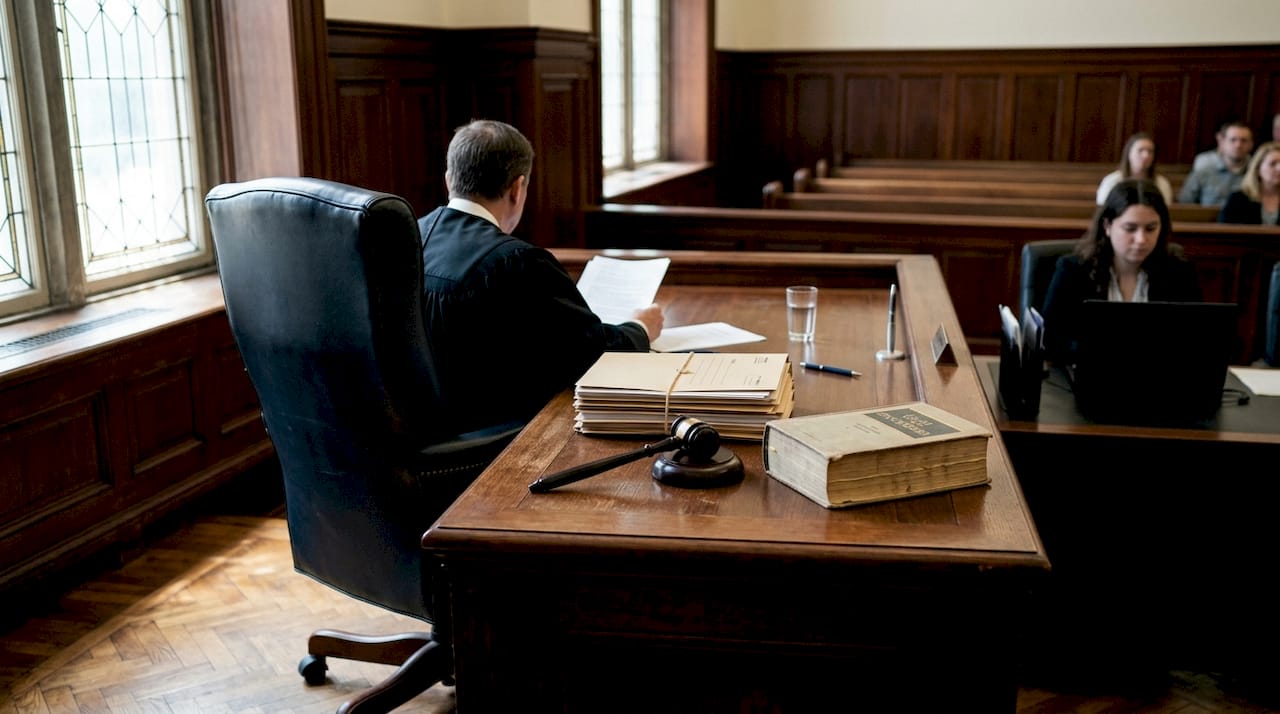
Ignoring a bench warrant also creates new criminal exposure. Failure to appear can be charged as a separate misdemeanor, carrying up to 90 days in jail and a $500 fine on top of whatever the original case involved. That means one missed court date can double your legal problems.
The risks compound over time. Warrants do not expire. The longer one sits active, the more opportunities exist for an unplanned arrest at the worst possible moment.
How to clear a bench warrant without going to jail
The most reliable method for clearing a bench warrant without arrest is filing a motion to recall or quash the warrant through an attorney. This is the standard legal tool courts use to cancel active warrants before any arrest occurs. Here is how the process works at a high level:
- Retain a defense attorney immediately. An attorney can file on your behalf, appear in court without you in many cases, and negotiate directly with the prosecutor before any hearing.
- File a motion to recall or quash. This motion is typically a 2–3 page document explaining why you missed court, providing supporting evidence, and proposing a new court date.
- Use a statutory attorney appearance. Under California Penal Code § 977(a), defense attorneys can appear in court for most misdemeanor cases without the defendant present. Many other states have similar provisions.
- Coordinate a voluntary surrender or “walkthrough.” If a physical appearance is required, your attorney can arrange a controlled surrender with same-day processing and release on bond.
- Appear at the scheduled hearing. If you must attend, your attorney prepares you fully and stands beside you. Judges frequently grant an “own recognizance” release when a defendant shows up voluntarily and prepared.
Pro Tip: Motions handled by counsel are often ruled on within 7 business days, with hearings lasting under 15 minutes. Speed matters here. The faster you file, the lower your arrest risk.
Step-by-step process to clear a bench warrant safely
The clear warrant process has eight concrete steps. Each one reduces your risk of arrest and improves your outcome in court.
Step 1: Confirm the warrant and case details
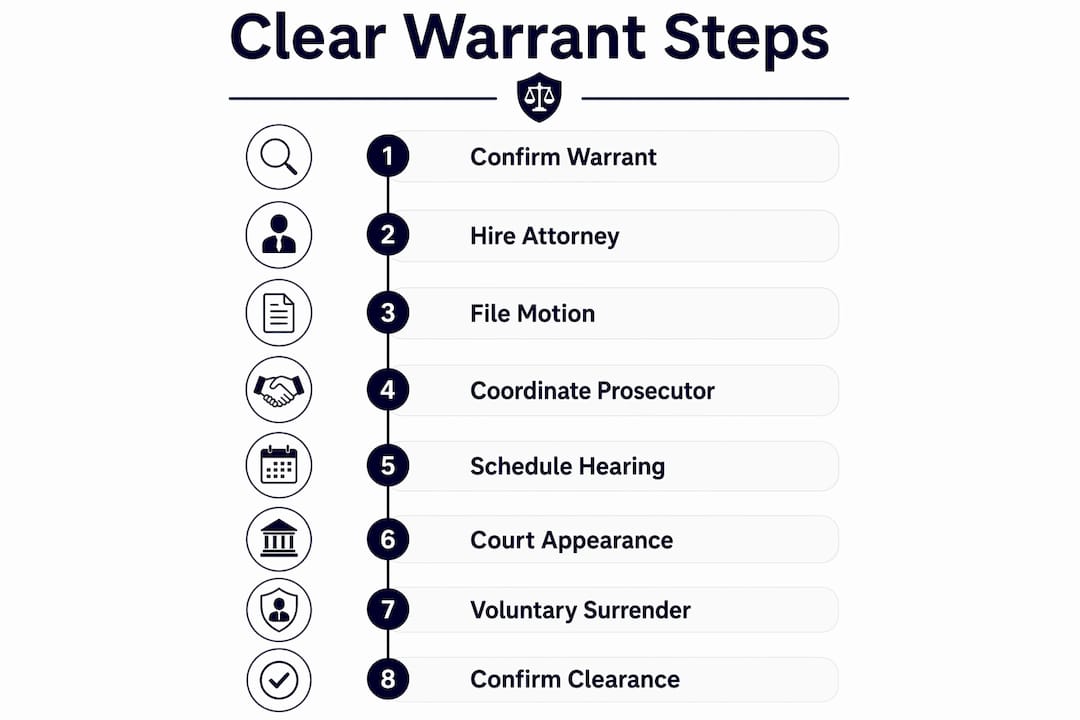
Start by verifying that the warrant exists and identifying the originating case. Your attorney can pull this information through court records. Do not call the court clerk yourself.
Step 2: Retain an experienced defense attorney quickly
This is the single most important step. Attorney-arranged surrenders result in same-day processing and release on bond, while unprepared self-surrenders can lead to 48-hour jail holds. The difference is preparation and legal standing.
Step 3: Prepare and file the motion
Your attorney drafts the motion to recall or quash. The document explains the reason for the missed appearance, attaches supporting evidence such as medical records or employer letters, and requests a new court date. Courts respond to documented explanations, not excuses.
Step 4: Coordinate with the prosecutor
Before the hearing, your attorney contacts the prosecutor’s office. A pre-filing conversation can signal cooperation and reduce the chance of the prosecutor opposing the motion. This step is often skipped by people who try to handle warrants alone.
Step 5: Schedule the hearing or attorney appearance
In misdemeanor cases, special appearances allow your attorney to appear without you. In felony cases or when a judge requires your presence, your attorney schedules the hearing and prepares you for what to expect.
Step 6: Attend court or have your attorney represent you
Show up on time, dressed appropriately, and with all documentation ready. If your attorney appears alone under a statutory provision, you simply wait for confirmation that the warrant has been recalled.
Step 7: Arrange voluntary surrender if required
If the court requires a physical surrender, your attorney coordinates a walkthrough. This is a controlled process where you arrive at a designated time, complete booking, and are released the same day. It is far safer than an unannounced arrest.
Step 8: Confirm the warrant is cleared in law enforcement databases
After the court recalls the warrant, verify that it has been updated in state and federal law enforcement systems. Your attorney can confirm this through official channels. A warrant that is recalled in court but not updated in databases can still trigger a roadside arrest.
| Step | Action | Key Risk if Skipped |
|---|---|---|
| Confirm warrant | Pull court records through attorney | Acting on wrong case info |
| Retain attorney | Hire defense counsel immediately | Uncoordinated arrest during surrender |
| File motion | Submit 2–3 page recall document | No legal basis to cancel warrant |
| Prosecutor contact | Pre-filing coordination | Opposition at hearing |
| Confirm clearance | Verify database update | Arrest after warrant is recalled |
Pro Tip: If you are on a commercial bail bond and missed court, bond forfeiture can trigger bounty hunter involvement. Contact your bail bondsman and attorney simultaneously. Do not wait.
Common mistakes and risks to avoid when clearing a bench warrant
Most people who end up in jail while trying to clear a warrant make one of these avoidable errors:
- Showing up at the courthouse unannounced. Without a scheduled hearing or attorney present, court security can detain you on the spot.
- Driving yourself to court. Parking lot arrests happen. Officers stationed near courthouses run plates and check IDs routinely.
- Calling the court clerk or law enforcement directly. Phone calls about warrants can inadvertently reveal your location and alert authorities without resolving anything. Clerks cannot quash warrants over the phone.
- Arriving on the wrong date or without paperwork. A missed hearing date on a recall motion can result in the judge denying the motion entirely.
- Trying to handle an out-of-state warrant without local counsel. Warrant procedures vary by jurisdiction. An attorney licensed in the originating state is required.
- Self-surrendering without legal preparation. Walking into a police station without an attorney’s arrangement is the highest-risk move available to you.
Voluntary surrender, when coordinated by an attorney, is viewed positively by judges. It signals responsibility and often results in leniency on bail and penalties. Uncoordinated surrender signals desperation and gives the court no reason to extend goodwill. The difference between the two outcomes is preparation, not luck.
What happens after clearing the warrant?
Clearing the warrant is not the end of the case. The underlying charge, fine, or probation condition that triggered the warrant still needs resolution. Addressing the root cause fully is the only way to prevent the court from issuing a new warrant.
Here is what to focus on after the warrant is recalled:
- Resolve the original charge. Work with your attorney to address the underlying case through a plea, diversion program, or trial.
- Pay outstanding fines or complete required conditions. Provide written proof of compliance to the court. Documentation prevents disputes.
- Update your contact information with the court. Missed notices are a leading cause of new warrants. Keep your address and phone number current.
- Set calendar reminders for every court date. Use your phone, a paper calendar, and a backup contact who can remind you.
- Arrange reliable transportation in advance. Car trouble and missed rides are among the most common reasons people miss court.
- Consider pretrial mitigation or diversion programs. Programs like PC 1001.95 Judicial Diversion or Mental Health Diversion under PC 1001.36 can resolve underlying charges while keeping you out of custody.
Sealing or expunging a failure-to-appear record is possible in many states after the case is fully resolved. Ask your attorney whether your jurisdiction allows it and what the waiting period requires.
Key Takeaways
Clearing a bench warrant without jail requires a motion to recall or quash, filed by an attorney, combined with coordinated court appearances and full resolution of the underlying case.
| Point | Details |
|---|---|
| File a motion immediately | A motion to recall or quash is the primary legal tool to cancel a warrant before arrest. |
| Hire an attorney first | Attorneys can appear on your behalf for misdemeanors and arrange safe surrenders for felonies. |
| Avoid uncoordinated contact | Never call clerks, show up unannounced, or self-surrender without legal preparation. |
| Confirm database clearance | Verify the warrant is updated in law enforcement systems after the court recalls it. |
| Resolve the underlying case | Addressing the original charge fully prevents the court from issuing a new warrant. |
What I’ve learned from watching people handle bench warrants the wrong way
Most people who end up in custody while trying to clear a warrant did not fail because the law was against them. They failed because they acted alone and acted fast without acting smart.
The cases I have seen go smoothly share one pattern: an attorney was involved before any contact with the court. The attorney filed the motion, made the calls, and either appeared alone or walked the client in under controlled conditions. The judge saw someone taking responsibility. That perception matters more than most people realize.
Voluntary surrender is viewed favorably by judges. It signals that you respect the court’s authority even when you made a mistake. Judges deal with people who avoid accountability every day. Someone who shows up prepared and accountable stands out.
The uncomfortable truth is that the legal system gives you a real off-ramp here. The motion to recall process exists precisely because courts know people miss dates for legitimate reasons. The system is not designed to punish you for one missed appearance. It is designed to get you back in front of a judge. Use that.
My strongest advice: do not wait for a “better time” to deal with this. Every day the warrant sits active is another day a routine traffic stop changes your life. Get criminal defense counsel involved today, not next week.
— Jake
Exectreatmentsolutions can support your warrant resolution
When a bench warrant connects to underlying charges involving substance use or mental health, legal strategy alone is rarely enough. Judges want to see evidence of accountability, and that evidence comes from documented treatment.

Exectreatmentsolutions provides court-approved pretrial mitigation and court advocacy services that work alongside your defense attorney. The team builds structured treatment plans, produces court-ready documentation, and supports eligibility for diversion programs including PC 1000, Judicial Diversion, and Mental Health Diversion. If your case involves substance abuse or behavioral health issues, Exectreatmentsolutions helps you present the strongest possible picture to the court. Contact Exectreatmentsolutions to learn how pretrial mitigation can support your path to reduced or dismissed charges.
FAQ
What is the fastest way to clear a bench warrant?
Filing a motion to recall or quash through a defense attorney is the fastest method. Motions handled by counsel are typically ruled on within 7 business days, with hearings lasting under 15 minutes.
Do I need a lawyer for a bench warrant?
You are not legally required to have one, but an attorney dramatically reduces your arrest risk. Attorney-coordinated surrenders result in same-day release, while uncoordinated self-surrenders can lead to 48-hour jail holds.
Can my attorney appear in court without me to clear the warrant?
Yes, in many jurisdictions. Under California Penal Code § 977(a), defense attorneys can appear for most misdemeanor cases without the defendant present. Many other states have equivalent provisions.
Will clearing the warrant also resolve my original charges?
No. Recalling the warrant removes the arrest order, but the underlying case remains open. Resolving the original charge through a plea, diversion, or dismissal is required to fully close the case and prevent a new warrant.
Is voluntary surrender better than waiting to be arrested?
Yes. Voluntary surrender, especially when arranged by an attorney, is viewed positively by judges and typically results in more favorable bail conditions and reduced penalties compared to an unplanned arrest.


